

Understanding Meta's Entity ID: Why Your 28 Ads Might Actually Be 3

There's a lot of chatter these days in the media buying world about Meta's newly introduced concept of the entity ID.
If you're running Meta ads and wondering why your creative testing isn't performing the way you expected, this concept might be the missing piece of the puzzle.
Let me walk you through what entity ID actually means and why it matters for your ad account.
👉🏼 [YouTube Explainer] - Using Motion to unlock new Meta Entity IDs
The Entity ID vs Creative ID Problem
When you launch a new ad into your Meta ad account, it gets assigned a creative ID. Simple enough, right?
But here's the catch: that creative ID does not necessarily equal what Meta is calling the entity ID.
In fact, you might actually launch a number of ads with different creatives, but Meta categorizes those different creatives as the same entity.
This has massive downstream effects in terms of where your money is spent in the ad auction.
How Meta Categorizes Your Ads
Let's look at some examples directly from Meta's own documentation to understand how they're bucketing your creative.
Example 1: The Obvious Case
Take two ads that feature the same image and the same product, with just slightly different text overlays.
This one's pretty intuitive—Meta is going to bucket these two distinct creatives as the same entity ID.
Makes sense. Same visual, same product, just different copy. They're essentially the same ad.

Example 2: The Counterintuitive Case
Now here's where it gets tricky.
Meta showed an example with different product photography and even a different product present.
Yet Meta is still categorizing these as the same entity ID.
This is the challenge that a lot of media buyers are running into right now. You think you're testing different creative concepts, but Meta sees them as variations of the same thing.

Example 3: Truly Distinct Entities
Meta's third example shows two quite distinct ads with different and distinct entity IDs:
- A traditional product shot
- A lifestyle image with a human present
These get categorized as separate entities because they represent fundamentally different creative approaches.

The Real-World Impact
Here's what this looks like in practice:
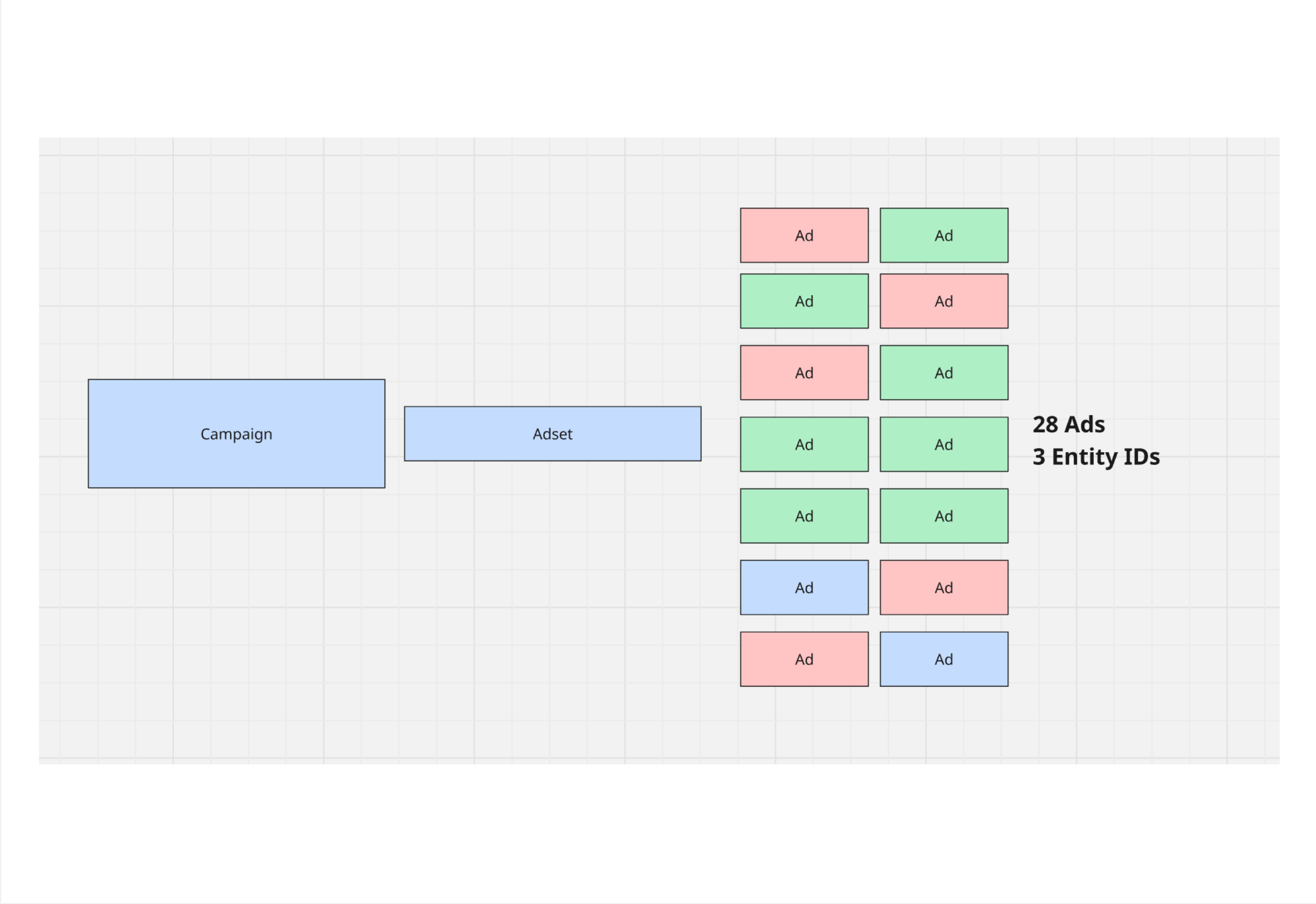
You might have a campaign with an ad set that contains 28 ads. Seems like great creative diversity, right?
But because not enough of those ads are truly distinct creative concepts, you might actually only have a small handful of entity IDs.
Those 28 ads might effectively be just 3-5 entities in Meta's eyes.
This impacts where your spend goes in the ad account and limits the auction opportunities available to you.
The Challenge for Media Buyers
As a media buyer or head of growth at a DTC company, the question becomes: How do we introduce new and distinct creatives that don't fall into the same Meta entity ID?
This is crucial because:
- Entity ID affects auction participation
- It impacts how your budget is distributed
- It determines whether you're actually achieving creative diversity
- It influences your ability to reach different audience segments
How We're Solving This: Using Motion's AI Tagging
Until Meta starts surfacing the entity ID metric directly in the ad dashboard, we're using a workaround with Motion.
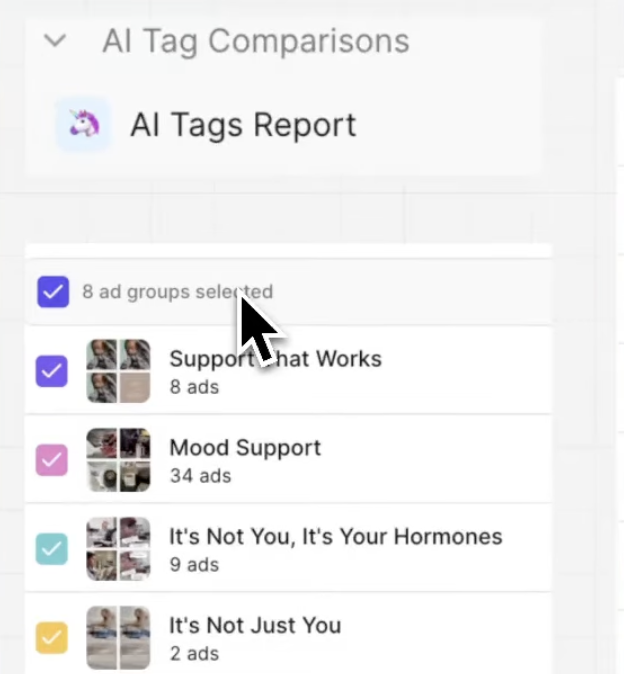
Motion has an AI tag report that tags different messaging angles, formats, and creative types with their own AI tagging system.
Our hypothesis? It functions somewhat similarly to Meta's AI tagging.
Here's how we use it:
Motion categorizes ads into buckets based on:
- Messaging angle - What the ad is communicating
- Creative type - The format and visual approach
When we're trying to unlock new entity IDs in the ad account, we first check whether that ad is unlocking a new AI tag bucket—either on the level of creative format or messaging angle.
If it does, that's a pretty good indicator that we've also simultaneously unlocked a new entity ID in Meta.
What This Means for Your Creative Strategy
The entity ID concept reinforces something we've been saying for a while: true creative diversity matters.
It's not enough to just tweak copy or change background colors. You need fundamentally different creative approaches:
- Product shots vs lifestyle imagery
- Different messaging angles (problem-solution vs social proof vs feature benefits)
- Various formats (static vs carousel vs video)
- Distinct visual styles
Small iterations don't cut it anymore. Meta's AI is sophisticated enough to recognize when you're just making minor tweaks to the same core concept.
The Bottom Line
If you've been wondering why launching 20 "new" ads didn't improve your performance or reach, entity ID might be your answer.
Meta is grouping similar creatives together, which means you're not actually giving the algorithm the diversity it needs to explore different auction opportunities.
Focus on creating truly distinct creative concepts rather than endless variations of the same idea. Your ad performance—and your budget efficiency—will thank you.
Want help developing a creative strategy that unlocks new entity IDs and maximizes your Meta ad performance? We analyze creative diversity for DTC brands every day. Send us a message to discuss your specific situation.
Check out our other articles.

Get started today.
We only work with a handful of clients per year. If you're interested, book a discovery with our founder to see if this is a good fit.
What we do
Grow & scale your paid media program with a boutique team of eCommerce advertising pros.
Case studies
See what we've done for other brands and how we can help you. Read their stories.